Friday, September 28, 2012

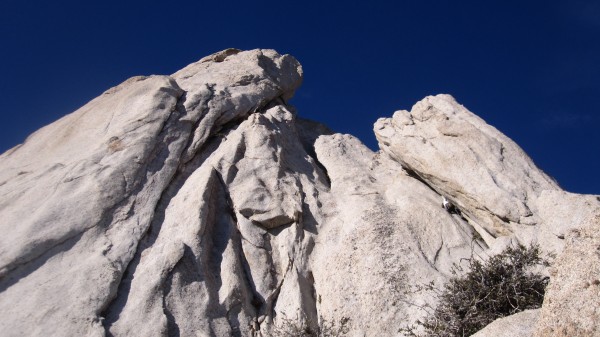
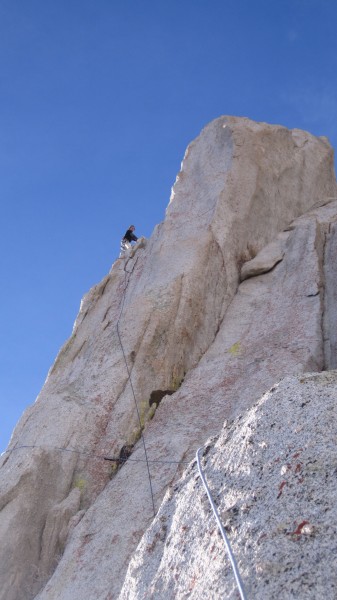
Day Needle- BCB on the Prow VI 5.10 A2

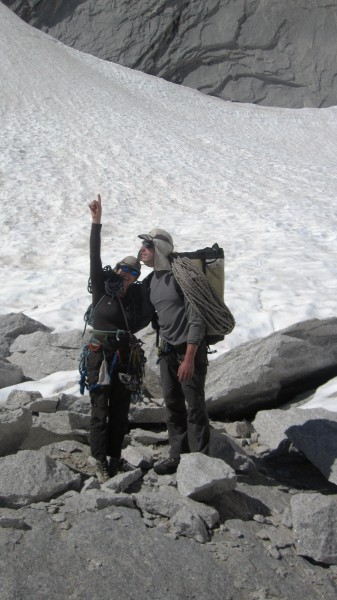
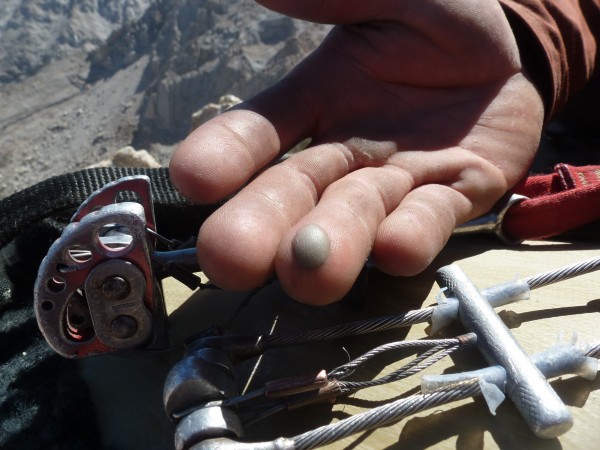
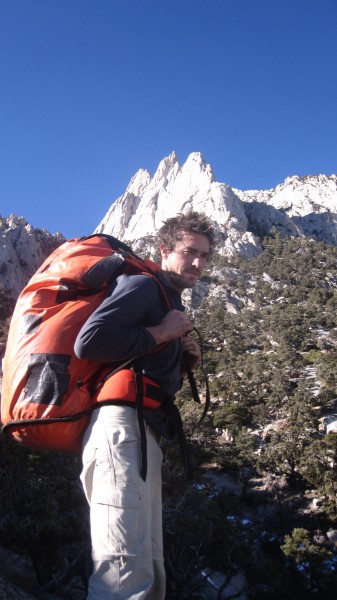
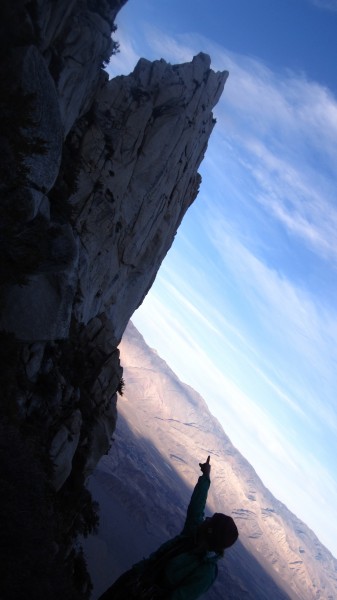
I smiled at one of the hikers coming off the summit of Whitney heading back on the main trail, but he didn't smile back! Myles explained that I had blood on my teeth from the split lip I had gotten after our 3 days/4 nights putting up a new route on Day Needle-or what's now known as Crook's Peak. To the hiker, we must have looked half-crazed...worn and haggered, carrying our heavy packs up to the Whitney summit in order to descend the Mountaineer's Route.

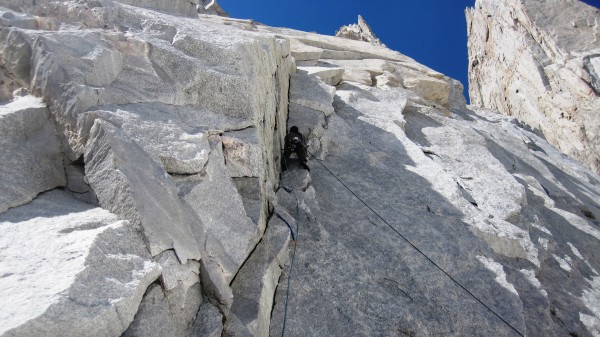
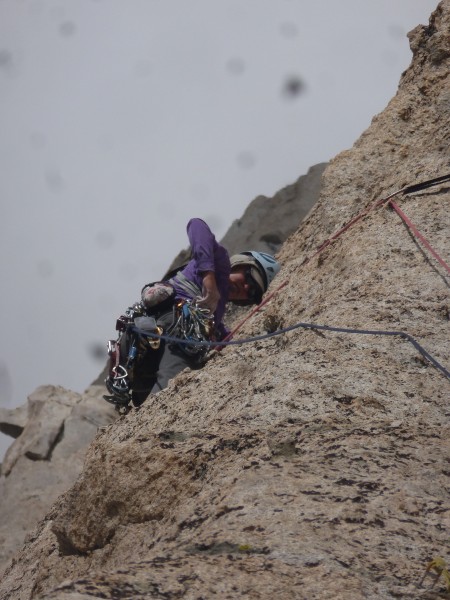
It didn't matter. I guess I had known this day would come. After moving to Lone Pine last year, my boyfriend Myles had informed me of his dream to put up a new route on Day-or as he called it, "the forgotten needle". Last season, all our energies were exhausted on a new route we put up on the portal buttress and our back country excursions were our breaks to 'just go climbing'! Anyone who has put up a hard, multi-pitch route knows that actually climbing the route is only a small part of the ordeal-hauling, tactics, scoping, protecting, etc. plays a much bigger role than the pure climbing. So, after finishing "The Never Ending Story" (which will have a trip report soon:), we were free to start our new project on Day Needle. Although we'd have preferred to start at the base with our portal ledge and get to the top, our work schedule of 4 days on/3 days off made this feat impossible. So, instead, we started slowly. After hiking up loads to the base, we chose our desired line up a right-facing open-book just to the left of the most obvious, green open-book on the center of the wall (which, upon investigation, was seamless). The 1st pitch was fun and easy, with no fixed protection necessary! The 2nd went quickly as well, traversing back right around bulbous, exposed moves on a dike which stretches all the way through the Whitney massif, and ending with a killer flake to belay on a big ledge. After sitting many hours on the cold, shady ledge while Myles began the difficult moves of the 3rd pitch, we called it a day and fixed our 300 ft. static line.

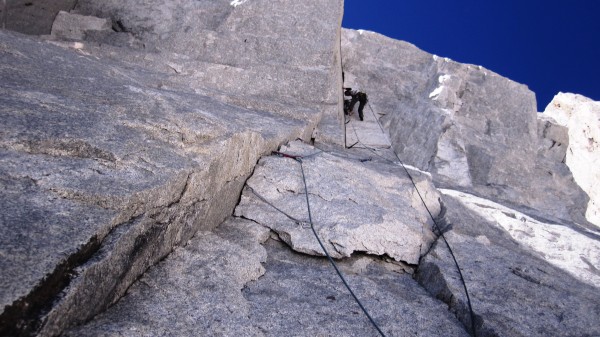
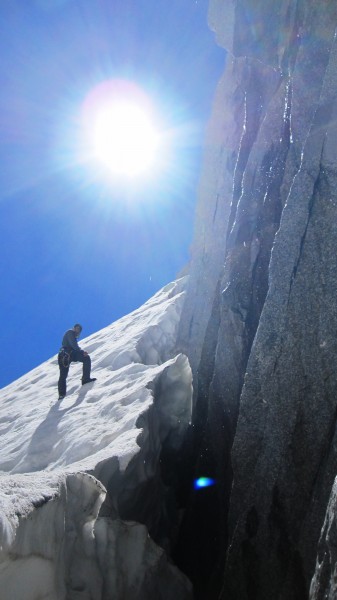
The next trip out, we hiked back up the snow and jugged our line (this time I was prepared with down jacket, hat, gloves, & long johns). I belayed Myles while he placed to button-heads and aided/freed some tricky moves to get to the base of the giant roof, all the while, watching the two parties climbing the Harding Route on Keeler in the warm, beautiful sunlight! We kept wishing for the roof section to slab out and become an easy, fun jam crack, however, as I had expected, it was steep and hard-A0. After starting up a 5.6R up and left after the roof with no bolts or pins to fix, Myles down-climbed the 5.6 and we called it a day. We only had 600 ft. of rope to fix, so we called it and went back to the portal again for work.

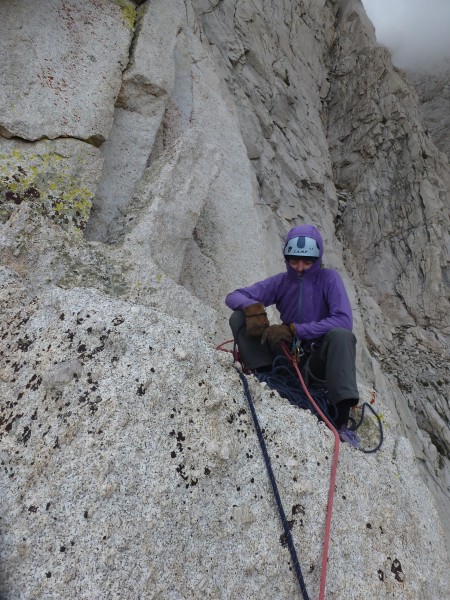
With permission for an extra day off, we went back out with the intention of a final push to the top. We had enough food & water for 4 days, one sleeping bag (with Myles' genius pizza design which allowed the two of us to sleep really warm using only one sleeping bag w/one sleeping pad!) and all the clothes and gear needed to get to the top. Waking up at 3am, we knew that we had to hike out, jug, haul, & climb a pitch in order to rap down to a bivy ledge we spotted. Big Day! After jugging our extremely overhung ropes to the belay at the 5th pitch, Myles led up the 5.6R again to get us to our bivy. We decided that because of the quality of the route thus far, we needed to push ourselves and go up the right facing open-book we had both been eying on the right. We knew it was going to be much more difficult, but the prettiest line should be taken. Our bivy ledge was somewhat smaller and more uncomfortable than we had hoped, but when the sun came up the next day, we started off again up the open-book which turned out to be smaller than 00tcu's. Myles fixed two pins and it went fairly smoothly. Pitch 6 turned out to be a much bigger undertaking-another hard, thin R facing open-book to a bolt ladder to a difficult snake crack. Again, Myles fixed protection as I sat freezing. But, when all was done, I got to free the beginning! The weather turned as I was climbing and all the sudden we were on the wall, getting hailed on, had no where set to sleep, and had just dropped our other rope...in other words, we were committed. Myles climbed quickly through a steep A0 crack from a mushroom-like formation on what we called the 'mini-headwall' to find our next bivy just before dark. We found a giant, loose ledge which looked much better than our previous night's accommodations. Hauling over the loose terrain proved a little difficult, and after hours of hammering and neglecting to eat or drink water, Myles had gone into shock. He curled up into a little ball and went straight to sleep. The next day we got to climb 2 pitches of easy terrain (5.4)but the exposure on the ridge was superb! I came to the base of a giant jam crack and brought Myles over. After the hard day he had before, he agreed to let me take it. 215' of #1's and .75's led to a large slabby platform. The next pitch proved much more difficult-overhung #3's. After taking a painful fall in which I straddled an extremely sharp arete on impact, I started pulling on pieces! Myles nearly freed it on TR, falling at the very end! After trying to go left and realizing that the crack system we wanted was to the right, I down-climbed to a killer belay an alcove behind a detached rock. Myles led on to the right to the base of a perfectly beautiful, but very difficult off-width. After repeatedly bumping up a #4, Myles called down that he had accidentally stepped on his cam. From there, he gunned it to the top. He called down that we were only one pitch from the top, but it was about to get dark and we still had a lot of tricky hauling to do. Luckily, Myles had reserved our camp spot when we hauled after the 10th pitch-our bags had conveniently landed on a ledge Myles had spotted from our belay. We fixed our 300 ft static and 70m lead line and rapped to our last bivy-our best night's sleep yet. Jugging up the steep wall the next morning, it occurred to me that we were about to summit. I hadn't climbed the o/w yet, so Myles jugged up and started hauling so that when the bag got stuck I could free it as I came up. The sand-bagger told me that as a lie-back, it would be an easy 5.7, so he left me with ladders, ascenders, approach shoes, 2 #3's, a #4, a rack of nuts, down jacket, gloves, and anchor to bring up on the R-side of my harness! It was not 5.7, and I couldn't do it clean with the weight and my level of exhaustion. At the end of the pitch, we made a cool move up and around a chalkstone. I took the last pitch up a catwalk and through a hole to the summit. We got on top and packed our bags to carry off. We had thought about going up a final crack instead of the catwalk, but it looked like there were many large, loose chockstones and neither of us really desired to go up it. When we go back to make it 5.11 A0, we'll probably try to finish it proper.

It's so funny how you work so hard to get to the top and then feel nothing. We cursed the giant, loose gully known as the Mountaineer's Route as we descended toward camp. Arriving just as a strong wind that moved around our tent started. The next day as we hiked down to get to work before 1pm, it started to rain-we had finished just in time:) While putting up the route, we found a fixed bong and a bolt right below the chalkstone on pitch 13. We contacted John Vawter to see if it was their route's end, but it seems to be a variation off the Becky route. We chose to use button-heads to minimize the appearance of bolts on pristine, alpine rock. Looking up now at the Whitney Massif, it has just begun to hit me that I have had the privileged of scaling all three...now, I just can't wait to bag the other beautiful needles and spires to the left:)
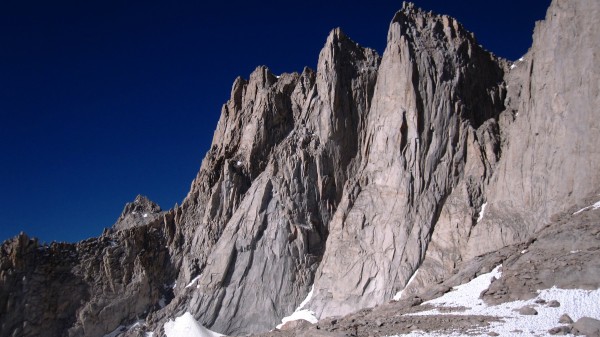
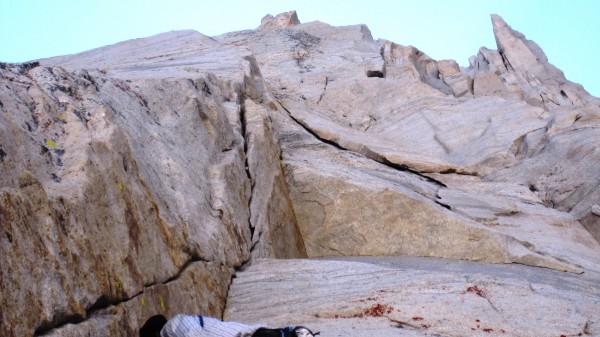
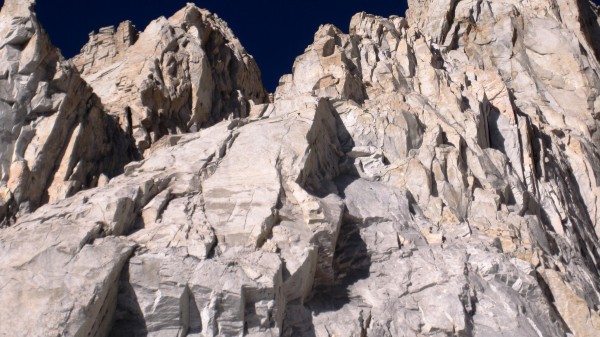
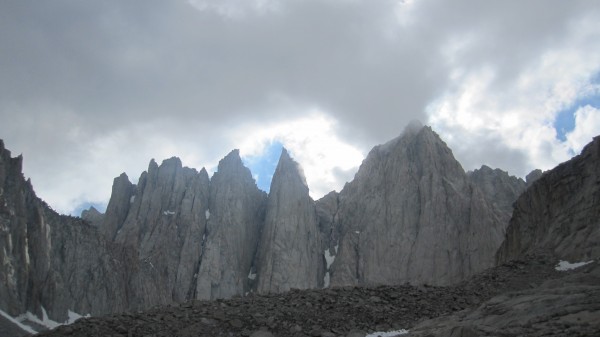
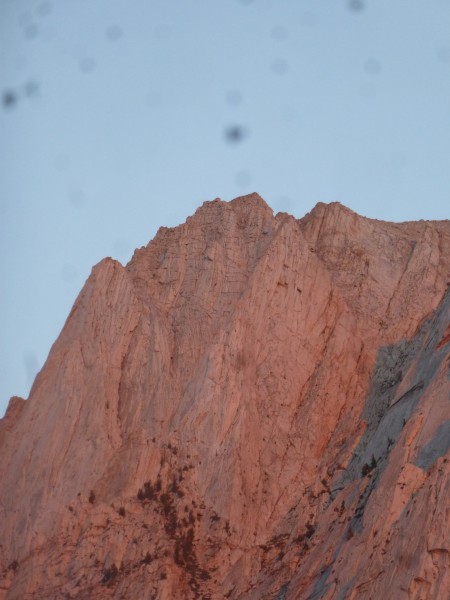
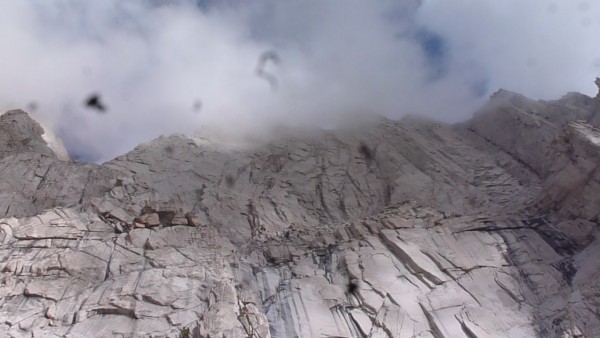
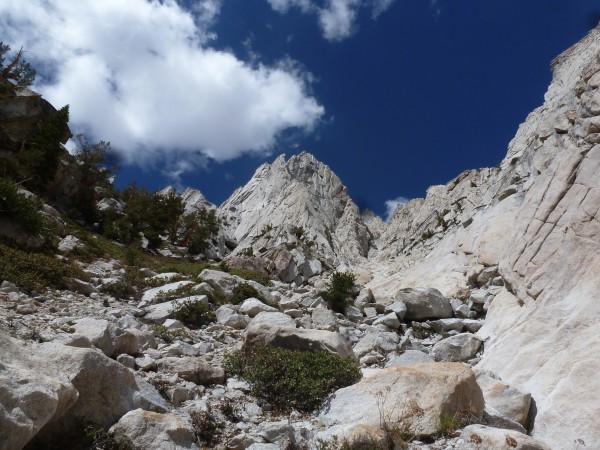
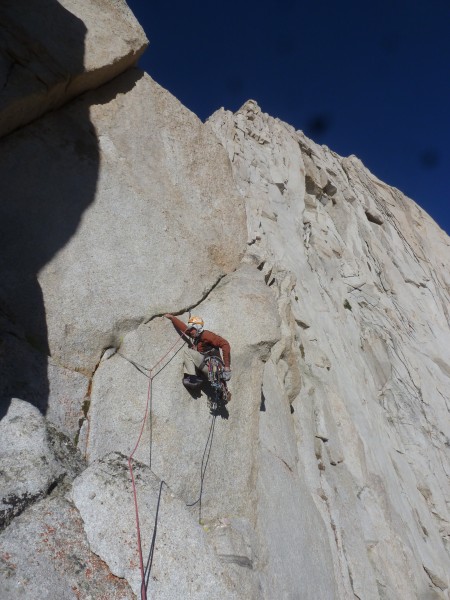
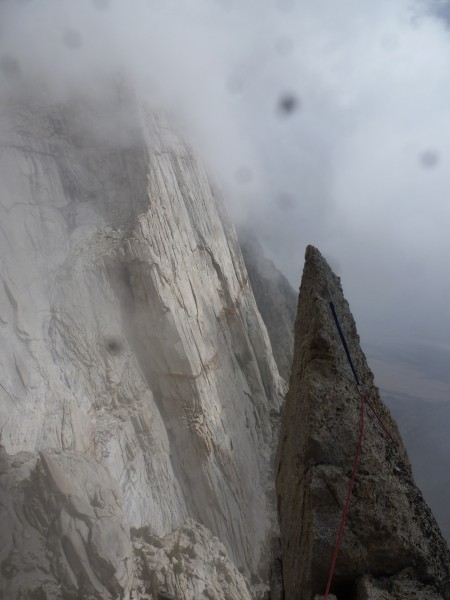
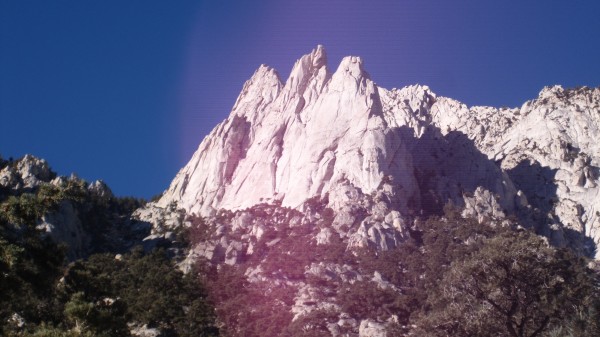
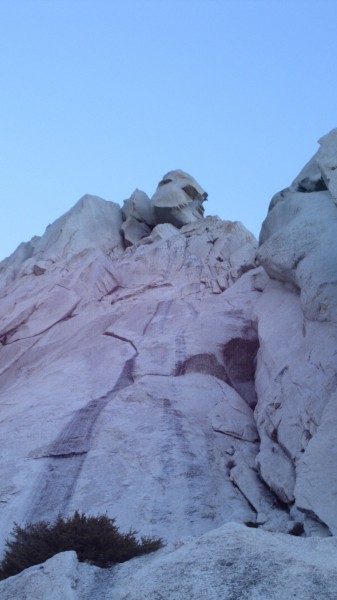
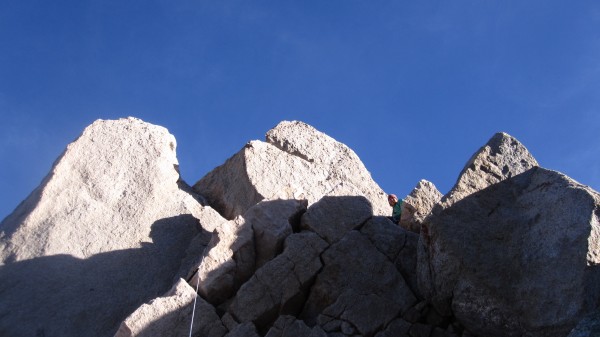
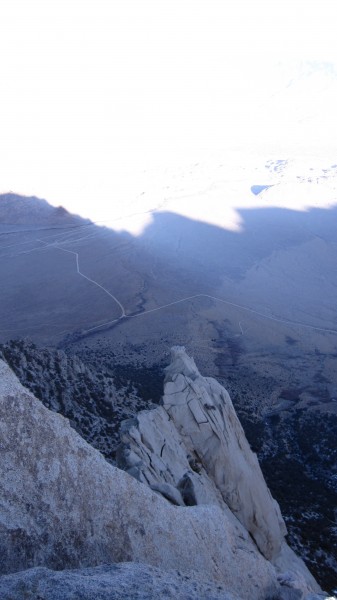
 day needle on the left of keeler needleSpire summit on the right, only nine pitches away.open books at base...we took the furthest to the leftThe giant roof, to blank slab, to one hell of an over hanging head wal...1st pitchthe whitney massif

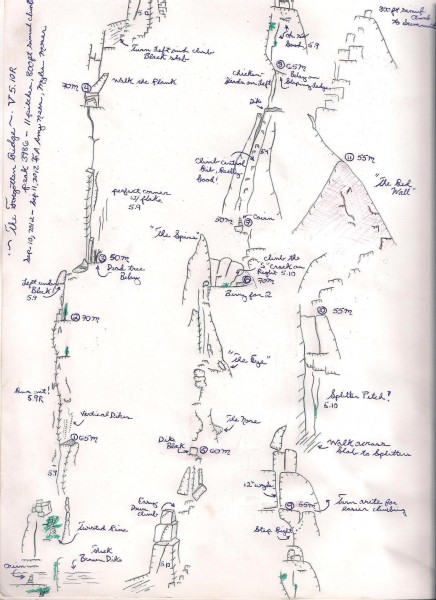
Peak 3986- The Forgotten Ridge V 5.10R Lone Pine Peak area


Sunday September 16, 2012 12:51pm
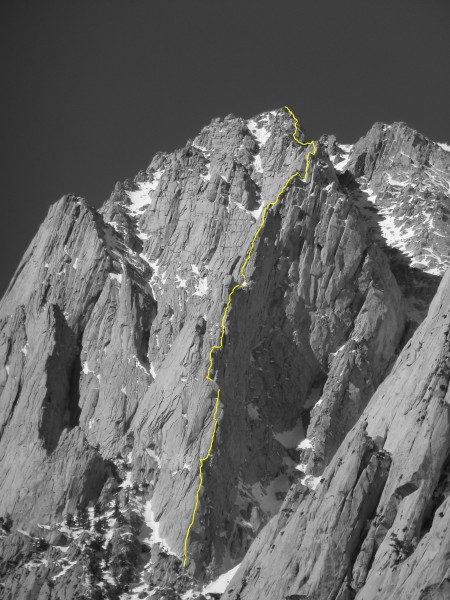
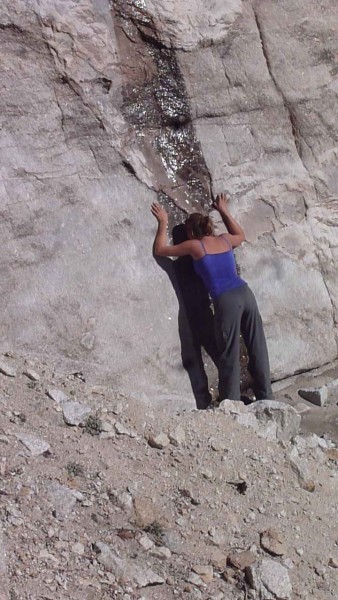
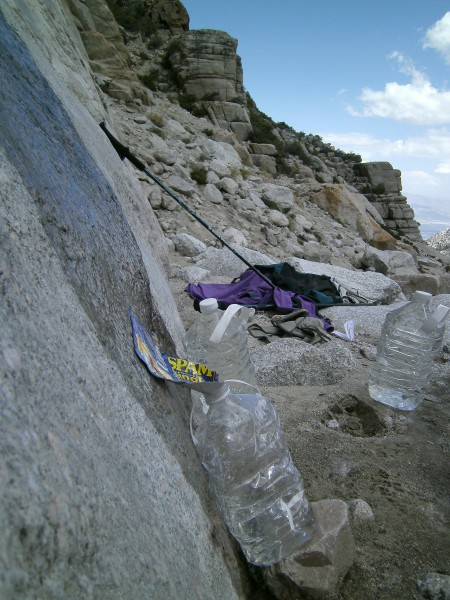
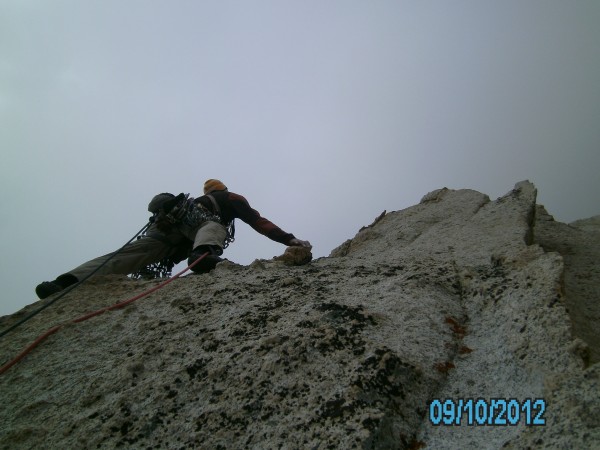
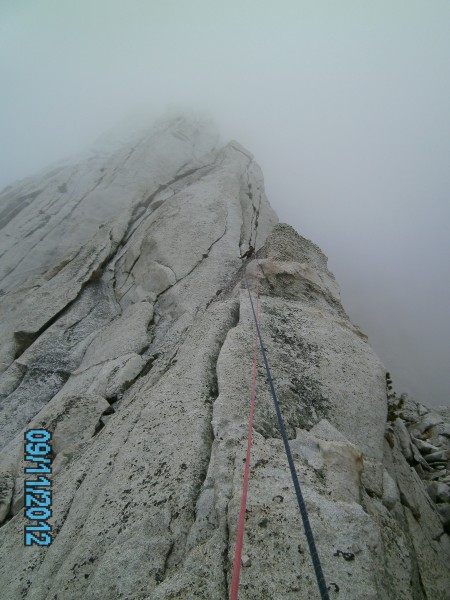
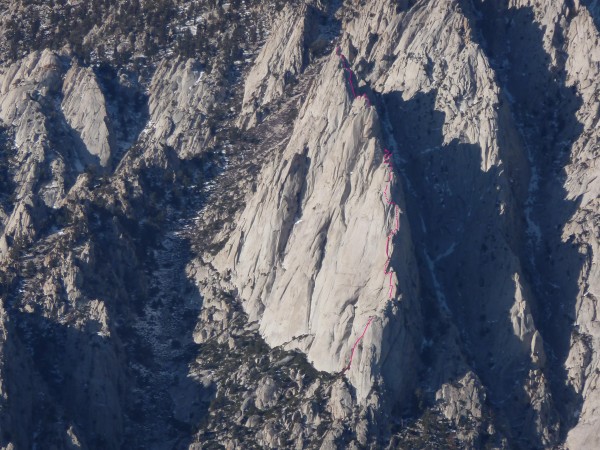
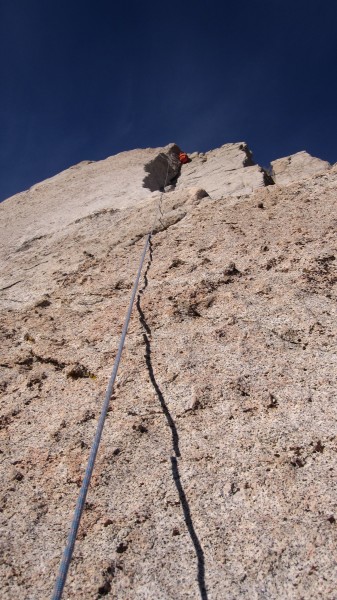
Amy Ness and I spent two days (Sep 11-12, 2012) climbing this long spiraling ridge. We managed to climb it in 11 very long pitches. The route had wide variety of climbing and terrain. We finished with an 800ft simul-climb to get the hell off. Worried about water along the massive hike up Tuttle Creek canyon we were truly surprised and over joyed when we found a seep of water coming out of the granite wall a few hundred yards below the start of the route. We sucked some granite slime and filled some jugs. The wall appeared to shrink as we got closer then only grew and grew as we started climbing. Here are some photos, topo, and route line.

Oh no!Route LineLook at that haul lineThe GlowApproaching the wallA bit funkyAmy on P2Somewhere... probably lostWe spent a lot of time in the cloudsooch!Pitch 10The "S" crack off the bivyThe BivyHuh?

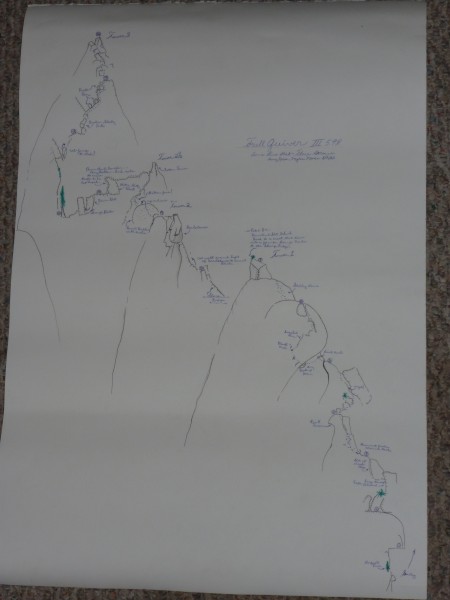
Three Arrows- Full Quiver IV 5.9 R


  On 1/2/12 we finally went for it! A massive formation hiding on Lone Pine Peak. A grand total of 14 pitches on a winter day for a first ascent... Not Bad! Adventure climbing at its finest.


The Line


 We just threw our haul bag off the first tower...


Seven pitches of wide stemming, large dihedrals, and run-out arêtes have lead us to this point. Changing our original plan of two days/one night on the wall, into a single push, we were forced to use the empty shell of a giant, orange haul bag.

Boots, gloves, hand drill and all nonessential crap were jettisoned.

The bag soared!

Two more towers to climb.

Pitch Eight was a down climb to a very sharp ridge. A short haul with our small bag of pitons and water jug almost sent me flying off the Eastside.
“Amy, when I say ‘Let Go’ I mean lower it out slowly… My bad!”

We are now in the notch underneath two giant headstones; guardians of the second tower. A bit of wandering around in the wrong direction, we decide the cat walk highway just makes sense.

Amy bags the Second Tower.

A giant, knobby boulder must be climbed, and then down climbed on the backside to a very, very rotten wall. A quick summit of Tower 2 ½…also very rotten.

Amy bags another.

She then takes me across another rotten, sharp ridge to a down climb boulder problem which I can only describe as pure shit!

“The hand and foot holds are pulsing and crumbling…” I yell.

I’m thinking to myself, “Amy was top-roped for this”. Our only option was to throw the rope around the rotten horn on the arête of the boulder and hope the holds don’t blow off. They’re still pulsing.

Back on solid ground. Some ridge climbing and quick down climbing around and through a hole takes us to the notch of the third tower. A huge pine tree marks the start of the next pitch. A splitter crack rises above the pine, a dead end. I turn around the arête and with a coil of rope in hand cat jump to the slab below. We climbed a broken dike, the gateway to the Death Zone! Guillotine flakes and suspended blocks must be used, oh so gently.

Through a cat claw shrub to some summit blocks… Amy bags the Third and final Tower.

A rappel off a pine tree drops us perfectly into the descent gully.
Fourteen very different pitches of climbing made up this adventure. The sun is still shining, but now, the real work…descending the snow in climbing shoes to find our bag!

HEADSTONES


PITCH SIX LOOKING FROM FINAL SUMMIT

Wings of Warren A4- Whitney Portal

Neil Woodruff and I established a boulder aid problem behind my work at the Whitney Portal Store. We used a combination of natural hooks and bat hooks. We place three button-heads on lead. Here I am on a natural hook that is about to rip off, while I'm drilling the next bat hole. A Talon Hook some how caught my fall. The wall is about 45 degrees overhanging, not sure how or why the hook held, but it was a good thing it did!

WINGS OF WARREN A4

Some how this video never made it on to the blog. This is what happens when we get bored... Enjoy!
 Amy and I are attempting the First Winter Ascent and Second Ascent of Windhorse V 5.10 A3 on the South side of Lone Pine Peak. We were about 300ft up when the storm rolled in. We sealed the doors and hunkered down for three days while it whited out, and dropped massive flurries off the wall.
Here we are on the final Attempt of Windhose. We spent six days in the Portaledge for the first Winter Ascent, Second Ascent, and First Free Ascent.We free climbed the A3 hooks at a grade of 5.11. Twenty-one pitches on a mega wall!

                                                   Windhorse V 5.10 A3  or
                                                                   V 5.11


Video By: Myles Moser
Write Up By: Amy Ness

I had just fallen over, again. This was nothing new. The giant haulbag weighed nearly as much as I do and coupled with the less than optimal snow conditions, I found myself in such a state several times since we had begun our descent. Myles couldn’t do much…his bag being even heavier than mine. But then, as I struggled to make my way out of my snowy entrapment, I heard voices.

We had just finished Windhorse, a 21-pitch climb on the south side of Lone Pine Peak, and hadn’t seen anyone for a week, yet here, on the summit are two fellow climbers joining us just in time to see me in my pathetic state! As it turned out, we had met one of them in the Whitney Portal last summer…small world. They had just soloed the NE Ridge of Lone Pine Peak, and Myles couldn’t help but notice their small packs. He convinced them to take some of my load- making me slightly more mobile for our long descent. Angels! Thanks again Ian and Dale.

We had brought an extra haulbag to fill so that we could jettison our large, orange piggy down the gully with the soft goods…we just had to make it to there first. The lack of winter snow this year has actually made our hiking to and from the route a total nightmare: a thin sheet of hard snow covers 1-3 ft of sugar, making post-holing inevitable.

We hadn’t intended to free the route. Our bags were loaded with everything the 1st ascentionists needed: hooks, copperheads, pitons, hammers, gear to 12”, etc. We had finished carrying our final load to the base exactly a week beforehand- one of several shuttling missions. Although abound with ledges, we decided to do a first winter ascent capsule style, with our double portaledge and 4-season rainfly…after being stormed off our first attempt, we came back just 3 days later with everything we might need for another such event.

I had already led the first two pitches the last time and was able to pass the 5.10 roof more easily this time around. Myles quickly led up the chimney pitches that followed now that the snow had mostly melted out. We camped at Weakened Worriers Ledge the first night, 5 pitches up, and just underneath the crux and most beautiful feature of the climb- a 3 pitch, left-facing dihedral.

Waking to a beautiful, sunny day, I led up the 5.9 loose section to a 2 bolt anchor. There was a slight moment of hesitation when I turned the corner and realized the dihedral, flanked by crumbling rock, had no chance for protection before reaching the bolts…about 20 feet. I stepped lightly, and waited for Myles to join me.
His pitch, the 5.10 A3, lie ahead. The idea was that he would free-climb until he couldn’t anymore, and then he’d call down for whatever he needed. His fall zone during the steep undercling at the beginning of the pitch was on top of me, which is probably why I didn’t realize he had forgotten the tag line until he clipped the 1st bolt about 25 ft. up. It didn’t matter. The rope kept feeding out. Bolt #2, bolt #3, “off belay!” He had freed it. I followed up placing my hands into the slots-much better than they looked from below! I got to the 1st bolt and he yelled down to treat it like the hills (our playground in the desert which requires a slightly different touch). I met him at the anchor. What a great pitch! We experienced our 1st flawless haul from there…the A0 or 5.11 crack lie ahead.
Although I tried to take it from him, our previous agreement was that he was going to free it, which he did. An overhanging crack to and off-width sent him over the lip. He credited his success that day to the 13-yr-old Sapporo I had found in a crack the night before…Good ol’ Brutus!

The next day the moment I’d been both anticipating and dreading arrived- the 5.10 squeeze o/w. Em Holland had informed me that this is were the gear to 12” would come in. Grades are funny things in climbing…I really couldn’t imagine what a 5.10 squeeze o/w would be like. I began up the 5.9 chimney pitch excitedly, although the large gear slowed me a bit. I passed the bombay chimney belay and all of the sudden, I was stuck. My helmet restricted me from turning my head; the extra gear got clipped to my last piece, as my feet frantically shuffled back and forth attempting to find a space small enough to span across…no luck. The squeeze constricted towards the top and I used all of my might to chicken-arm and knee scum. One move up, one move down. Finally, after all the energy I had left was about to dwindle away, I managed to move up enough to gain momentum. After what seemed like a lifetime, I reached the anchor. Pulling up the extra rope and haul bucket made me want to throw-up. Only the next day would I see the damages to my knee and elbow! Myles joined me and it was time to haul. All the while I was contemplating why I do this- why don’t I live a normal life, with a normal job, and normal hobbies? Who in their right mind looks up and says, “Oh, it would be so much fun to see if I can wiggle my body up this granite gap”?

Following Myles up the next pitch of weird, snakelike, bulbous grooves reinstated my love for climbing. I took the next short pitch up to the top of a detached, knobby pinnacle where there was supposed to be a bolt marking the beginning of the double tension traverse. Myles found it on the facing wall and we rappelled back down to the anchor of the o/w to set up camp…all I wanted was to be away from the heinous thing, but it was our best option for a bivy. On the way down, we noticed something curious…the tension traverse where the piton was placed looked freeable. By skipping the short pitch up the detached pinnacle, a short downclimb to climber’s right led to a tree belay where a thin undercling led out to the fixed piton. After clipping the piton, a downclimb on slab looked possible to get to the 3-bolt anchor on a giant ledge. That night we discussed the possibility. Regardless, we decided our best option for hauling would be to cut our bags from the o/w to the 3-bolt anchor at the end of the tension traverse…we would just have to wait and see what the rock gave us the next day.

We jugged up our lines in the morning and decided to go for it. It was my pitch. I racked up plenty of small gear and took off. Both the climbing and the protection were awesome! I clipped the sturdy piton and downclimbed placing another cam before reaching the ledge…that was it. We had freed the entire route! I made some pitiful attempts to gorilla call. Myles was ecstatic. He met me at the anchor and we rejoiced briefly before cutting our haul bags.

The 4th class section that followed ended up being about 500 ft. We fixed our lines with several anchors breaking it up so we could shuttle loads with our ascenders, Everest style. It was exhausting, but better than hauling on 4th class terrain. We came to the base of the 5.7 dike, a beautiful ledge with trees and a view. We set up camp on the slabs below and awoke early the next day to a double sun-the sun rising over the Inyo Mts. being reflected upon the Owens Lake. We were waking earlier and getting sun later now that we were high up on the wall…I guess that’s the key to getting more daylight hours in the winter!

Myles went up the wet, icy dike. The hauling, once again, was horrible. We had become accustomed to using our lead line as a fixed rope during hauling because nearly every time one of us would have to rap down to free the bags and then jug back up. It took hours. Exhausted and not looking forward to more wide climbing, I went up the 5.8 chimney filled with rocks, snow, and ice. I placed a purple TCU just before I found the fixed piton at my back. I turned the lip and brought up Myles. We looked at the 5.6 gully filled with snow and rocks ahead, Myles detoured right to find us a good bivy and a much easier haul. We decided it would be better to spend one more night on the wall rather than be forced to set up our rainfly as a tent on the snowy, windy summit. The night before on the slab, neither of us got more than a few hours sleep due to some fierce winds, and we seemed to be in a wind block where we were.

The next morning, Myles climbed a cool flake to splitter cracks linking us to the final 4th class summit push. We hauled and fixed lines on the 4th class again to get just below the summit plateau. Upon reaching Myles with the final load, we celebrated for just a second before realizing what lie ahead: our bags were very heavy and the descent was covered in enough snow to make the journey down miserable. I had never carried something so heavy, and I pitied Myles who, being the man had to carry even more.
Bringing us back to the beginning of my story…

After splitting ways with our Angels, we continued to descend in the dark. Finally, it was too hard to see the saddle we were aiming for, and we decided to spend one last night on the mountain. Correlating with the story of Bruce and Em (the first ascentionists), we found ourselves missing a sleeping bag on our last night. It had exploded from the orange haulbag that was thrown down the gully. Luckily, Myles had his homemade 1-piece suit and we were much lower in elevation so the night wasn’t too horrible. Myles hiked back up and recovered the bag in the morning while I continued toward the saddle wearing one bag and dragging another behind me. Finally, the 8th day since hiking up, we arrived at the Stone House. It had begun to snow about an hour beforehand, and we were both running on autopilot- grateful that we knew the trail well. The entire experience was one of the most difficult and rewarding I have had yet. Can’t wait to see Em and give her the Sapporo can that her and Bruce had
left for us to enjoy!

Keeler Needle Attempt One

 
    All Right! This video is part of My First Attempt with Desert Blair. Blair and Barrel Chest humped probably 300lbs pounds of equipment from 8,500ft to about 12,000ft to the base of Keeler Needle.Blair became very ill with Altitude Sickness, and was forced to come out. He was a great help along with Barrel Chest. Without them it would not have been possible.

   Then Amy and I are back on the wall for a six day attempt, where we encountered five days in really bad snow storms.We were hoping to catch the winter ascent but....Oofta!  We ultimately bail deciding that just getting up the wall any way would not work.

Keeler Needle- Blood of the Monkey VI 5.12, 16 pitches


Write Up by Amy Ness:

June 1, 2012

It was day 5 on the wall. We had just both been shut down by a very thin, very pumpy crack we now know to be the 5.12 crux. I was getting worried when the clouds started rolling in, but the snow flakes were only gently dancing down. The second we got into the ledge, all hell broke loose. Storms on this route were nothing new to us, our first attempt in March had us stranded inside for 5 of 6 days, finally forcing retreat. But this storm was different. I watched the top of the rainfly, wondering if it would blow out. Wondering if this was it.

"Are you scared?" Myles asked me. We were sitting across from one another in the portaledge, indian style, as to avoid touching the aluminum frame. Ice marbles were pounding down onto our thin-walled rainfly with what seemed like the force of a fire hose. We could hear booms of thunder and feel the lighting in the air. "Yeah", I replied after surveying my surroundings. I didn't want to hear that he was, too.

March 22-27, 2012

The idea to put up another free climb on Keeler Needle came to us this winter when we had planned to second Jeff Lowe and John Weiland's route (V,5.9 A2). During the 6 days on the wall, we discovered we could pick and choose the best looking line between Ammon McNeely's Australopithecus (a.k.a. Southern Monkey VI, 5.9 A3) and the Lowe Route. On that attempt we began up a right-facing open book, past a tooth-roof which we had thought to be the start of the Lowe Route (it was not), we then traversed up and left to Ammon McNeely's "Great White Shield". The name says it all, a killer, yet strenuous, C2 crack which passes through two short roofs. With shouts of joy, Myles passed the roofs only to see that the crack was about to get harder, getting thiner and thiner. Another explosion of excitement from above told me he had just freed it. The Great White Shield is now 5.11 and absolutely amazing!

Hanging off Southern Monkey's anchors, we looked at our next obstacle, free climbing the A2 hooks. Myles lowered down on the anchor quite a bit to avoid the drop zone. I stepped left to the remaining seam of The Great White Shield, then back right, riding dishes up and over Myles. Wham!!! I was in his lap. Another go. I was further out this time and came screaming off… upside down! After finally working out the sequence of the traverse, I encountered a snow covered ledge. Some digging by hand finally revealed some stone, but the two parallel seams lying ahead were going to require pitons. We called it a day. By morning the snow had melted out and Myles started up the parallel seams, swinging and wheeling the hammer while free climbing. Knife Blade one, Knife Blade two… Off Belay! We had free climbed what we have come to call The Upside-down Screamer Traverse (A2 hooks or 5.10c).

We finally arrived at the crack I had been waiting for: pitch five, 200 feet of Lowe's Splitter! Everything I love in a crack- blue to yellow tcu's, .5 camalots and perfect jams. I encountered an old hex right before it started getting wyde, a quick sling of the relic, and I kept pushing. Then all of sudden, I let my guard down. I was flying through midair, wondering when I was going stop. Past the hex I flew, then past a cam, and another, before I stopped! Unhurt and dangling below several pieces of gear, the cold in my hands and feet suddenly hit me like a train. I still don't know what caused my thirty footer…freezing feet, icy ledge, or icy crack, but whatever caused it, we were forced to make the inevitable decision. We packed it in and decided that pushing through the storms via hook, crook and ladder just would not do. The haul bag flew, the chute deployed, and the bag exploded!

Another storm rolled in.

Every time I looked up to the mountains, it haunted me- the bailing, the failing, all that work for nothing, but then, finally, the time had come. May 28, 2012 we were back on the wall with the sun blazing. To our surprise the first pitch had grown an extra 20 feet with the melting of the snow. A bivouac under the Great White Shield set us up for 2-3 pitches a day. The following morning Myles made easy work of the Shield and I took the rope in the crotch on the Upside-down Screamer Traverse, before sending it on the next attempt. The haulbag took a pendulum underneath Lowe's Splitter followed by an easy haul. Now it was time for redemption. The ice was gone and the sun was hot. The 200 feet of perfect crack went off without a hitch. I even found a piton which had been buried in the snow where I had fallen last time. Another bivy under Lowe's splitter set us up for the virgin ground of the unknown.

Hauling 72 lbs. of water, 12 days of food, bolts, pitons, hammers, portaledge, sleeping gear, etc. was slowly killing us. To make matters worse, during our second haul, my lens popped out of my sunglasses. The next day, blinded by the sun, Myles was forced to saw my remaining lens in half and use climbing tape to ma-giver a makeshift pair of shades, draining our tape supply. Bloodied hands and knuckles were forced to scrounge tape from whatever held the prized, sticky substance. We learned that extra sunglasses and climbing tape would never be forgotten again.

Towards the end of the day a choice had to be made- linking into The Lowe Route where the giant Red Dihedral opens and takes off, or left, turning a hairy arete to the unknown. Myles took us to the left in an attempt to finish pitch seven. He had to place two 1/4 inch button-heads by hand, a long tedious process eating up the rest of the day. The next morning I followed up the 5.11 exposed arete that feels like sport climbing at 13,000 feet. It was quite an experience, and I felt a small twinge of guilt for whining about belaying in the freezing cold so that those bolts could be placed. I came across Myles' fixed piton on the leftward traverse and understood the excitement and fear he had vocalized while placing it. Two more button-heads for the anchor and we were hauling. As we hung there looking up, we knew we had hit the crux. The beginning looked tricky, but it appeared to be sinker jams that slabbed out towards the top. The gear was sparse at the beginning, and I flew down towards Myles. I preceded to lead up it three more times, pulling the rope every time. Blood was seeping from my gobies and the pump in my forearms only got worse with each attempt. Myles lowered me and gave it a shot, he fell at the same spot and decided aiding to the top while cleaning would be best so we could work it. Day five, pitch eight, and we just got slammed!

This brings us back to the storm… June 1, 2012

Just as Myles was lowering from the top, the snow started falling. We hurried to set up camp while the wind tossed the portaledge in spirals. Then the hail. We jumped in our capsule just as it really hit. The stove was lit for heat as we sat there starring at one another, wondering what had just happened. We hadn't drank or eaten much all day but my appetite was suddenly gone. We tried to be positive by thinking that at least we could collect water if we had to wait out the storm, but things were looking grim at the moment, and we were scared.

The hail raged on...

Keeler was angry!

We woke to clear skies, but our energies were low…sleep had been sparse with the howling winds throughout the night. We had to keep pushing our bivy higher up on the wall, yet we vowed to rappel back down to the 5.12 crux and attempt to free climb it again. As often it happens with new routes, we had to decide, right or left once more. To our right, The Castle Death Flake guarded a beautiful crack at the top of pitch eight. A massive flake so fragile and delicate, it could only be described as natural art. To the left, was a great looking undercling which disappeared around the corner. We chose the cling to avoid taking off the awesome flakes. As I climbed upward, much to my delight, the pitch was great. A few crux moves made the pitch 5.10, but soon after I found myself on 5.8 terrain and ended my pitch below the enormous, overhanging headwall. A beautiful jam crack shot straight through the steep wall, disappearing into a ledge system. We decided to save this for the following day.

The next morning we dropped the 300 foot static rope back down to the 5.12 pitch. I knew I only had about two tries before I would be too pumped to try it again. The first time, I fell three times! By the second try, I felt confident that I knew all the moves and that it took good gear, but I fell again. I had freed every move on that pitch, but just couldn't link them together. It was now day six and the climb had to continue.

We jugged back up and Myles climbed that perfect jam crack above our camp, then jogged up the ledge system to the right. When he got to "The Red Explosion Dike" he put in a 3-bolt anchor for a hanging belay. We camped another night at the base of the headwall and discussed how we were utterly amazed by what had just happened. We managed to squeak by the steepest part of the wall with one bolt and a ledge system we could ride half way up the overhanging wall at only 5.11. Unfortunately, our next day did not go as planned. We went the wrong way! After spending most the day putting in two bolts and fixing a piton in the wrong direction, I took over and aided up a garbage seam directly above the belay. The winds blew vigorously forcing Myles to bury himself with all the extra ropes and equipment at the belay. He jugged franticly once the rope were fixed, unclipping and leaving the gear still in the wall, not wasting anytime. He came up to me freezing and shaking from the windchill. We wrestled our flying ledge into the rainfly that turned into a kite. Myles feet were icicles as I rubbed them with hand warmers and placed them in my armpits for warmth. The wind shook our hanging palace throughout the night.

June 4, 2012- Day 8

The wind and cold continued the next day. The plan was to go down on fixed ropes, Myles working the pitch on his grigri trying to find the way, me removing one of the unneeded bolts and piton. He was excited, progress looked good and "the climbing was great!" he shouted. Once the path had been decided, the bolts were placed and we were ready to free it. An incredible technical traverse through The Red Explosion Dike using underclings and side-pulls led to more splitter cracks. Hand warmer in my chaulkbag, I was ready for the onsight. The jams, and finger locks were so good that even though my feet slipped out, I was able to hang on. We were ecstatic! This was the gatekeeper of the climb and we knew we could free the rest of the Giant.

Day nine- I headed up pitch twelve until the rope drag became a nuisance forcing me onto a perfect perch to bring up Myles after 180 feet. We swapped leads and Myles took us 60 feet up a blocky dike to the Harding Ledge. The Final Headwall laid before us. Most parties finishing the Harding Route at this point escape to the North side for a loose garbage summit push. The crack straight up from the Harding Ledge is awesome and set us up for the last two pitches. The hauling, however, was horrendous! A massive 350 ft haul almost killed us. The norm for this trip and many other Sierra routes we've done involved hauling until the bag became stuck. Forcing me to zip down and free it, while Myles would haul the Pig. Jugging back up this time through the overhanging wall so close to the summit, I just wanted to be done.

Myles turned the last technical move to the South side of the Needle, taking us to the ropes end. I followed with the ropes trailing behind me. We decided I would take us to the summit and then shuttle our belongings on fixed lines. I passed the Kenny Cook plaque with a quick read and final scrabble to the summit. There was no celebration. We weren't done until everything was off the Masiff. It took us two shuttle trips and a tyrollean of the portaledge bag to get just below the summit as it got dark. We were out of water, out of juice and out of light. We set up the portaledge one last time 30 feet below the summit, picking the marmot hair out of the last remaining snow patch outside our door.

June 6, 2012

We top out one last time with short hauls once the sun rose. With our enormous bags packed we started up the main Mt. Whitney Trail to the summit, to descend the Mountaineer's Route. We told anyone who would listen to let our bosses at the Portal Store know that we would be down the next day and that we were fine. Getting down with all the equipment needed for this kind of expedition is always a slow, monotonous ordeal. By the time we got to base camp and looked up at Keeler, we were too exhausted to feel much of anything. It wouldn't be until a few days later driving up Whitney Portal Road, that the excitement crept back into my gut and I realized… We had freed the Needle!

Blood of the Monkey VI,
5.12, 16 pitches
14,288ft.
Single Push Free Ascent, Capsule Style
May 28, 2012- June 6, 2012

Special thanks to our gracious Bosses at the Whitney Portal Store, Desert Blair, Barrel Chest, Elevation, Mammoth Mountaineering Gear Exchange, and my very driven partner.